
Why Knowing English Is Not the Same as Speaking English
Millions understand English but freeze when speaking. Learn why this gap exists, how fear blocks fluency, and what actually helps people speak confidently.
"I know English, but I can't speak it."
This sentence is repeated by millions of people around the world. They can read emails. They understand movies. They write messages without hesitation. But when it's time to speak — the mind goes blank.
This is not a personal failure. It's a design flaw in how languages are traditionally taught.
Understanding vs Producing a Language
Language has two distinct skill sets that don't develop at the same rate:
- Passive skills: reading and listening — absorbing language
- Active skills: speaking and writing — producing language
Most education systems heavily train passive skills. Grammar rules, reading comprehension, and vocabulary lists fill the curriculum. Speaking, however, requires something different entirely:
- Real-time thinking under pressure
- Confidence when making mistakes
- Muscle memory in your mouth, tongue, and pacing
- Emotional regulation when stakes feel high
Without regular, low-pressure speaking practice, fluency never develops — no matter how strong your grammar is. You can know every rule and still freeze the moment someone asks you a question.
The Role of Fear in Spoken English
Fear is the biggest invisible barrier to spoken fluency.
People worry about:
- Sounding foolish or uneducated
- Making grammatical mistakes
- Being corrected publicly
- Being judged for their accent
The brain interprets these social risks as threats and activates a mild stress response — which blocks word recall. That's why your English disappears exactly when you need it most. It's not a memory problem. It's a nervous system problem.
Ironically, the more you care about speaking well, the harder it becomes. The anxiety itself creates the block.
Why Classes Often Don't Solve This
Group classes have structural limitations that make the fear worse, not better:
- Limited speaking time per student — in a class of 10, you might speak for 5 minutes total
- Social comparison — everyone hears your mistakes
- Performance pressure — speaking in front of peers feels like an exam
- One-size-fits-all pace — you move forward before you're comfortable
Learners often leave class knowing more rules but feeling less confident speaking. The environment teaches them to associate English speaking with pressure and judgment.
What Actually Bridges the Gap
Research on language acquisition consistently points to the same factors:
Volume of output matters more than studying
The single strongest predictor of spoken fluency is how much time you spend actually speaking. Not reading about grammar. Not watching videos. Speaking.
Repetition of familiar scenarios builds automaticity
When you practice the same type of conversation — say, a job interview or ordering at a restaurant — your brain stops working hard on sentence construction and starts retrieving whole phrases automatically. That's when speech flows naturally.
Low-stakes environments lower the affective filter
When there's no judgment, no audience, and no consequence for mistakes, the brain relaxes and language access improves. This is why some people speak English perfectly with close friends but struggle in formal situations.
Consistency over intensity
Short, daily practice builds more fluency than occasional long sessions. The brain forms and strengthens speaking pathways through repeated activation, not marathon study.
How AI Practice Changes the Equation
AI-based conversation practice removes the emotional barriers that stop people from speaking.
With an AI conversation partner, learners can:
- Speak without fear of embarrassment
- Repeat the same conversation until it feels natural
- Make mistakes freely without social consequences
- Practice at their own pace, any time
This creates a virtuous cycle: Practice → confidence → better speech → more practice.
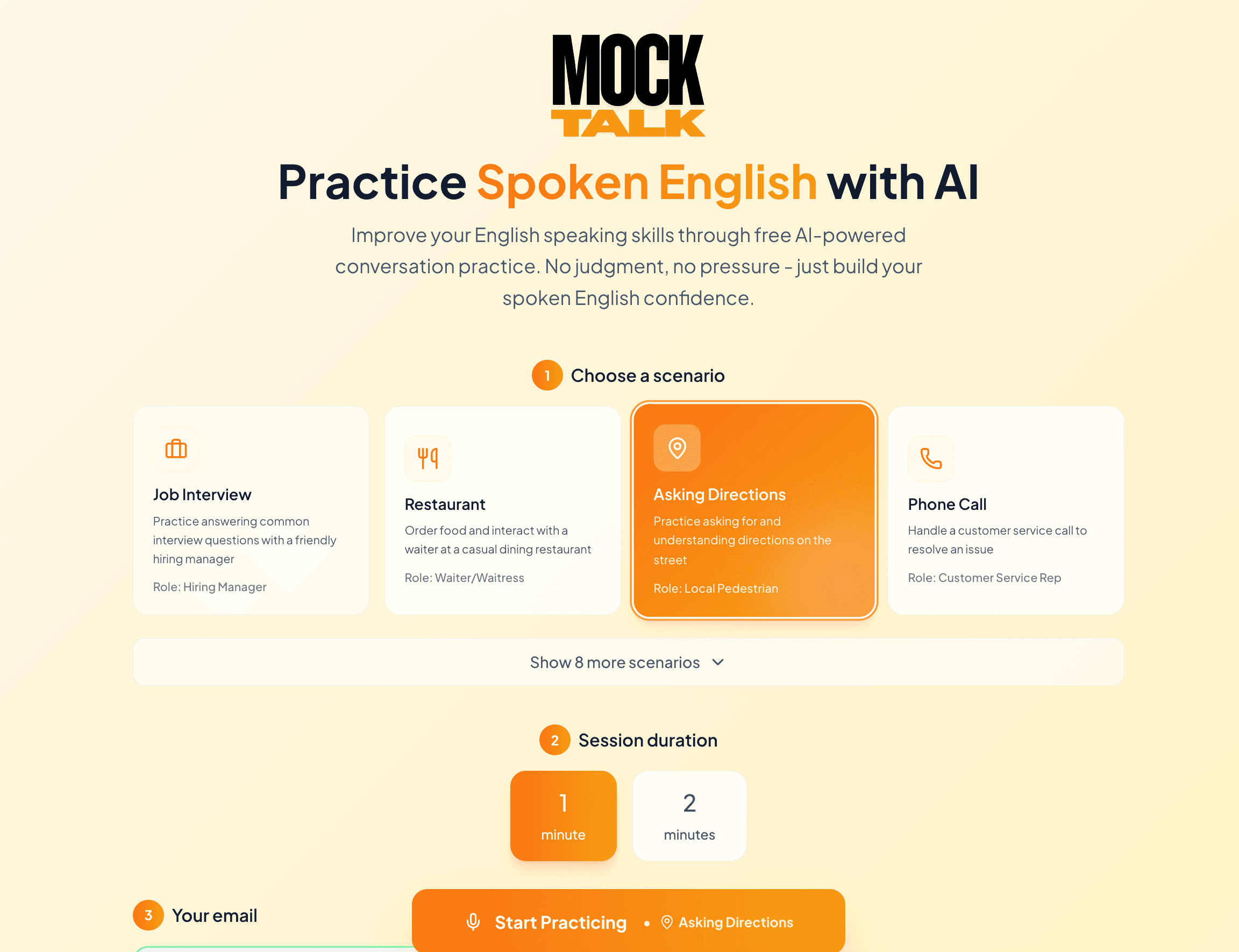
You can start with a low-pressure scenario like asking for directions or shopping at a store, and build up to more demanding ones like a job interview or a doctor's appointment.
Speaking Is a Skill, Not a Talent
Fluent speakers are not "naturally good at English." They simply spoke more — often badly — before they spoke well.
The solution isn't more studying. It's safer, more frequent speaking. Start with short, private practice sessions. Build the muscle memory. Let confidence follow naturally.
The gap between knowing English and speaking English is not a knowledge problem. It's a practice problem.
Start a free conversation practice session now — no download needed.