
How to Practice Spoken English Daily Without Fear or Judgment
Daily spoken English practice is the fastest path to fluency. Learn how to build a low-pressure routine that removes fear and makes consistent practice easy.
Fluency is not built in long study sessions or weekend classes. It is built in small, repeated speaking moments.
Five minutes of actual speaking does more for your English confidence than five hours of grammar study. Yet most learners don't practice daily — not because they lack discipline, but because speaking feels uncomfortable, and the brain avoids discomfort.
The good news: there's a simple way to make daily practice feel safe enough to stick with.
Why Daily Practice Beats Weekly Intensive Sessions
Language learning is a neurological process. Your brain forms new pathways for producing language through repeated activation — not through long, infrequent bursts.
When you practice speaking daily, even for a few minutes:
- Vocabulary becomes retrievable faster
- Sentence construction becomes more automatic
- Hesitation decreases over time
- Your brain starts treating English as a familiar activity, not a threatening one
Missing days breaks the activation pattern. Resuming after a gap feels like starting over. Consistency — even imperfect, short consistency — beats intensity.
The Real Reason People Avoid Daily Speaking Practice
Most learners cite time as the barrier. But when you dig deeper, the real reasons are:
- Fear of mistakes — speaking means getting things wrong, and that feels bad
- Fear of sounding foolish — even alone, people judge themselves harshly
- Not knowing what to say — open-ended practice feels overwhelming
- No clear routine — "practice English" is vague; without structure, it doesn't happen
The solution isn't discipline. It's removing the friction that makes speaking feel hard.
Reframing Practice: Rehearsal, Not Performance
Most learners treat speaking like a performance — something that will be evaluated. It should be treated like a rehearsal — something private, repeatable, and allowed to be messy.
Rehearsals aren't meant to be perfect. They exist so that the performance (a real conversation) feels familiar. Once you internalize this shift, daily practice becomes much easier to sustain.
You're not performing for anyone. You're drilling a skill.
A Simple Daily Spoken English Routine
Here's a realistic routine that takes 5–10 minutes and actually builds fluency:
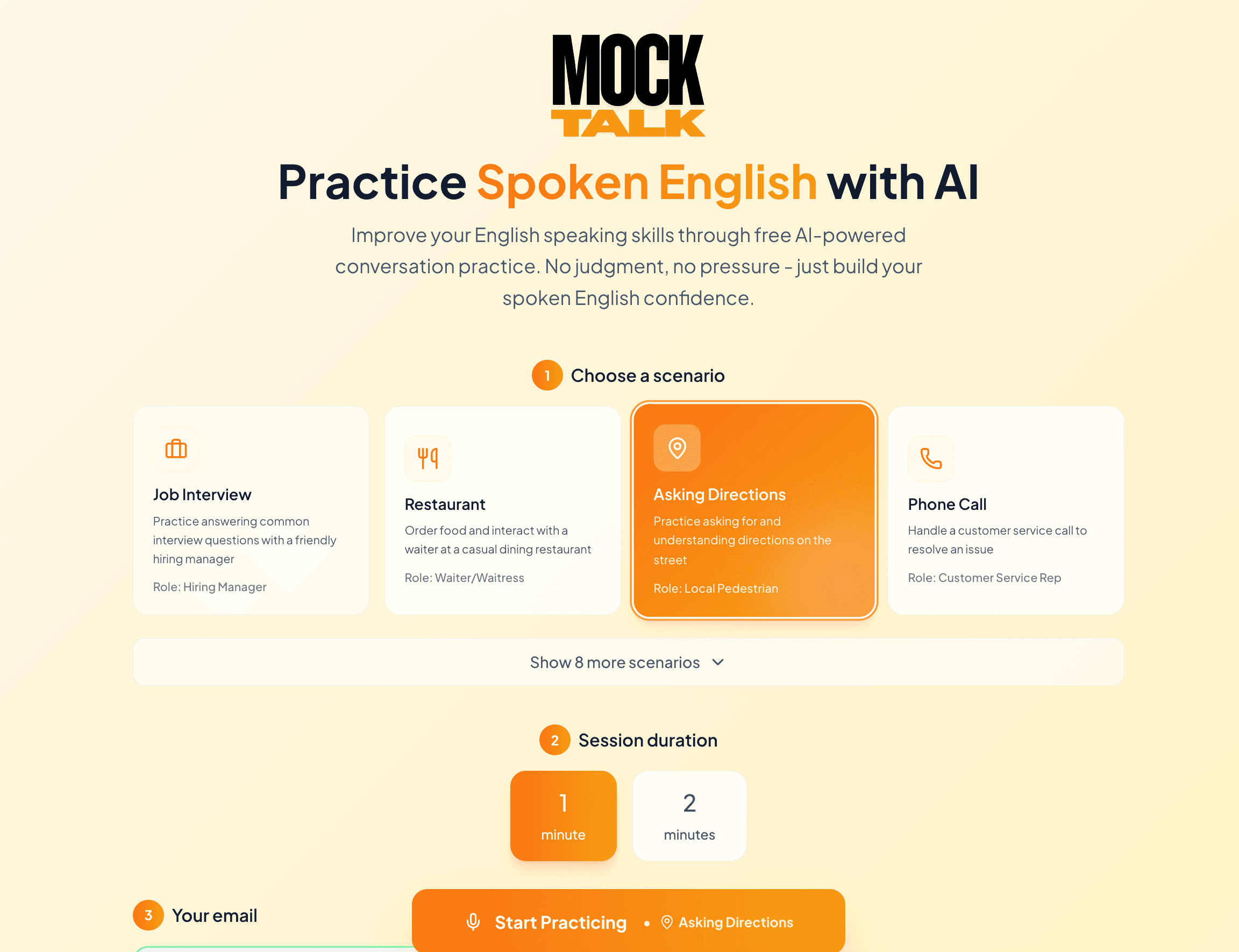
- Pick one scenario — a job interview, restaurant visit, phone call, or any situation relevant to your life
- Speak for 5–10 minutes — respond naturally to the AI conversation partner
- Focus on clarity, not perfection — getting your meaning across matters more than grammar
- Repeat the same scenario for several days — until it feels easy and automatic
- Move to a new scenario — only when the previous one feels natural
Why repeat the same scenario?
Repetition builds automaticity. The first time you practice a hotel check-in conversation, you're consciously searching for words. By the fifth time, you're retrieving phrases automatically. That's fluency in action.
Why Judgment-Free Practice Accelerates Learning
When there's no social judgment:
- The brain's threat response stays off
- Word recall is faster and more accurate
- Sentences form more naturally
- Mistakes don't create negative associations that make future practice harder
This is why private, AI-based practice environments are so effective for building confidence. When no one is watching, you speak more freely. And the more freely you speak, the more fluency you develop.
Contrast this with a classroom setting where a mistake earns a correction in front of 10 people — the embarrassment creates a memory that makes future speaking more stressful, not less.
Scenarios to Start With
The best scenarios to start with are ones that feel low-stakes but mirror real life:
- Asking directions — short, clear exchanges that build basic confidence
- Shopping — asking questions and understanding responses
- Restaurant ordering — specific vocabulary and polite requests
Once those feel comfortable, move to higher-stakes scenarios:
- Job interview — structured questions you can prepare for
- Doctor's appointment — describing situations clearly under pressure
- Meeting introduction — small talk with a new colleague
Progress You Can Expect
With 5–10 minutes of daily practice, most learners notice real changes within 2–4 weeks:
- Less hesitation when starting sentences
- Shorter pauses while thinking
- More automatic phrase retrieval
- Increased confidence in real conversations
Fluency grows quietly — then suddenly. One day you realize you answered a question without thinking about it first. That's the goal.
Start your daily spoken English practice — free, no download needed.